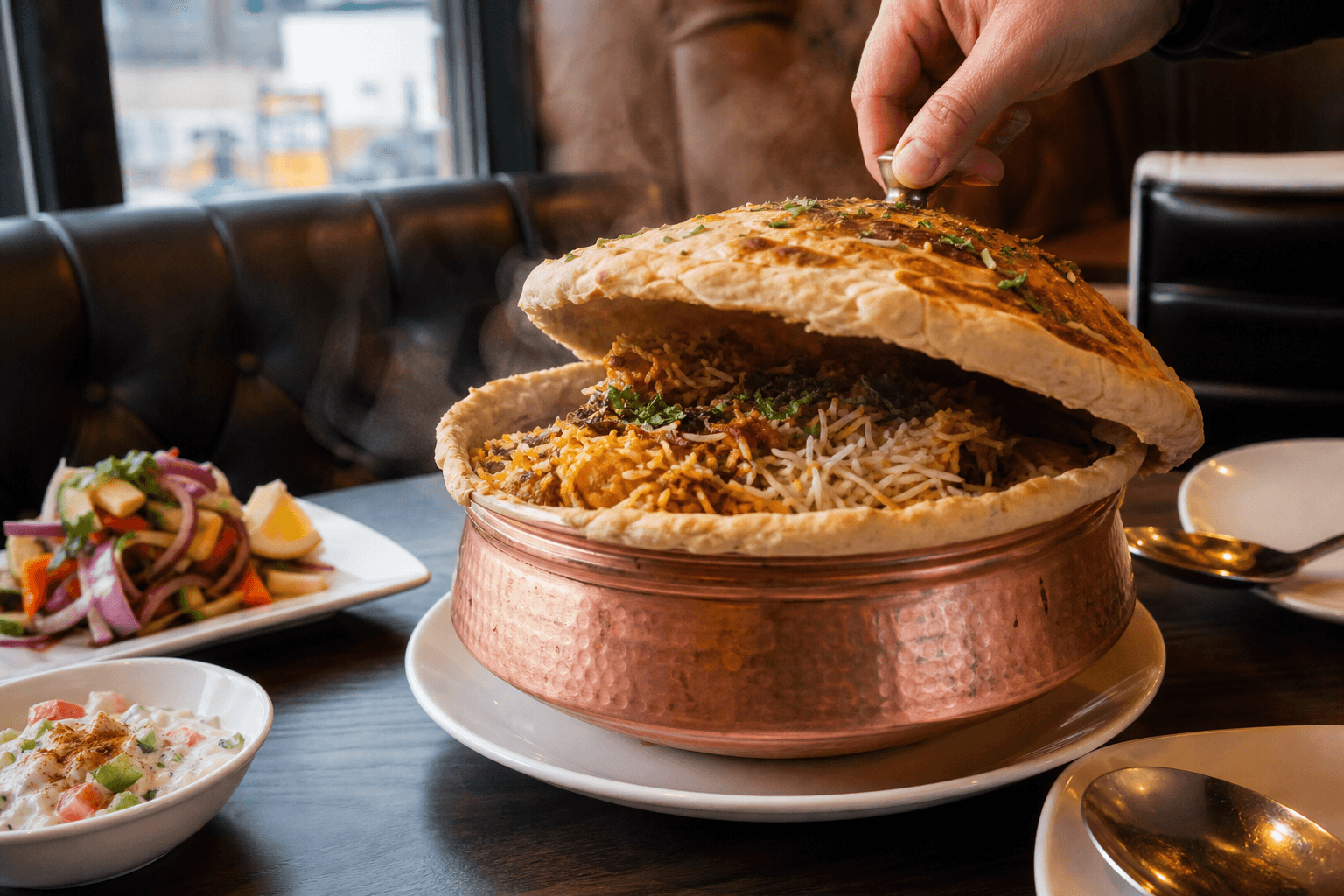
If you have searched for “biryani layering Kitchener” or “layered biryani Kitchener,” you are likely trying to understand how the dish is prepared before choosing where to eat. Layered biryani generally means that seasoned ingredients and rice are arranged in successive layers, rather than being combined uniformly from the start.
That description explains the structure of the dish, but it does not confirm one fixed recipe or cooking method. Restaurants may use different ingredients, rice styles, seasoning levels, and finishing techniques, so it is worth asking a few focused questions before ordering.
Quick summary

- Layered biryani describes how rice and seasoned ingredients are arranged.
- Layering can create variation in aroma, seasoning, texture, and presentation, but it does not guarantee a particular result.
- Layered biryani and dum biryani are related terms in some recipes, but they do not mean exactly the same thing.
- Before ordering in Kitchener, confirm the preparation style, available options, current location availability, spice preferences, and portion suitability.
What layered biryani means
At a high level, layered biryani is built by placing seasoned ingredients and rice in successive sections of the dish. A lower layer may contain seasoned vegetables, meat, paneer, or another filling, followed by rice. Additional layers can then be added before the dish is finished according to the restaurant’s recipe.
The important point is that “layered” refers primarily to arrangement. It does not, by itself, tell you which protein or vegetables are included, how spicy the dish is, whether the rice was cooked separately or together with other ingredients, or whether the dish was finished using a sealed-pot method.
When served, the layers may be mixed by the kitchen, gently combined at the table, or left for diners to portion through themselves. The exact approach depends on the restaurant and the specific biryani. If you prefer separate rice and filling, ask how the dish is presented rather than relying on the label alone.
Why layering can change the eating experience

Layering may affect how the dish is experienced because different parts of the serving can contain slightly different balances of rice, seasoning, aromatics, and other ingredients. One bite may be more rice-forward, while another may include more of the seasoned filling or garnish.
It can also create a visually distinct presentation. Separate areas of rice and filling may be easier to notice when the dish arrives, particularly if the restaurant keeps the layers intact until serving. Aromas can also be experienced in stages as the dish is opened, portioned, or combined.
These are possible characteristics, not promises. A layered dish is not automatically more flavourful, moister, spicier, or more authentic than another biryani. The quality of the recipe, ingredients, seasoning, rice preparation, and finishing method still matters.
Regional recipes can use different terminology and ingredient combinations. If you are comparing menus for a group or event, understanding the differences between South and North Indian catering styles can help explain why similar-sounding rice dishes may not taste or appear the same.
Layered biryani versus uniformly mixed rice dishes
A uniformly mixed rice dish combines the main ingredients more evenly throughout the serving. Layered biryani keeps more of the arrangement visible during preparation or presentation. Neither format is automatically better. The right choice depends on whether you prefer a consistent bite or more variation across the dish.
| What to compare | Layered biryani | More uniformly mixed rice dish |
|---|---|---|
| Ingredient arrangement | Rice and seasoned ingredients are placed in distinct sections or layers. | Rice and other ingredients are distributed more evenly together. |
| Flavour distribution | Bites may vary depending on the layer or ingredient included. | Seasoning and filling may feel more consistent from bite to bite. |
| Texture cues | Some portions may contain more rice, filling, or topping than others. | Components are more likely to appear integrated throughout the serving. |
| Presentation | The arrangement may be visible when the dish is served. | The dish may look more blended or evenly combined. |
| Best question to ask | Will the layers remain separate, or are they mixed before serving? | How evenly are the rice and other ingredients distributed? |
This comparison is a general culinary distinction, not a rule that applies to every restaurant. A dish described as layered may be served differently depending on the kitchen’s process, and a mixed rice dish can still have carefully prepared seasoning and texture.
Is layered biryani the same as dum biryani?
Not necessarily. Layering describes the arrangement of rice and other ingredients. Dum usually refers to a finishing or cooking approach associated with retaining heat, aroma, and moisture in a covered vessel. The two concepts may appear together in some recipes, but they are not interchangeable terms.
Do not assume that a menu item described as layered was prepared using dum cooking. If that distinction matters to you, ask whether the dish is layered, dum-finished, or prepared using another method.
What to ask before ordering biryani in Kitchener
Whether you are choosing a Kitchener Indian restaurant for yourself, your family, or a larger group, a few questions can make the order easier to assess:
- How is the biryani arranged? Ask whether it is layered, mixed, or presented with the rice and filling kept separate.
- What choices are currently available? Confirm which vegetarian or protein options are on the current menu.
- Is it available at the Kitchener location? Menus and availability can vary by location.
- Can the spice preference be discussed? Ask what adjustments are possible and whether the dish has a set heat level.
- How is it intended to be served? Find out whether it is a single-diner order, sharing dish, or group option.
- Does the timing suit your plan? For an event, ask about advance ordering, pickup, and catering arrangements.
Using the menu and location as your next check
La Tikka Indian Fusion is a casual dining Indian fusion restaurant with a Kitchener location at 200 Highland Rd W, Kitchener, Ontario N2M 3C2. Its menu categories include rice and biryani, alongside North Indian, Indo-Chinese, chaat, tandoori, sizzler, momo, and other offerings.
The current menu is the best place to check which biryani choices are listed and whether the description answers your preparation questions. The restaurant also supports dine-in, online ordering, reservations, and catering, so the best route depends on whether you are planning an individual meal, group visit, or event.
Do not assume that a rice-and-biryani category confirms a particular layering method. If preparation style matters, use the menu as a starting point and ask the Kitchener team to clarify the current dish.
A simple layered biryani ordering checklist
- Choose your preference: Decide whether you want visible layers, an evenly mixed dish, or simply a well-seasoned rice meal.
- Check the current Kitchener menu: Look for available biryani choices and location-specific details.
- Confirm preparation: Ask whether the dish is layered, mixed, dum-finished, or made another way.
- Discuss dietary and spice needs: Confirm ingredients and explain preferences before ordering.
- Match the order to the occasion: For a group or event, ask about reservations or catering arrangements.
Frequently asked questions
Does layering make biryani more flavourful?
Not automatically. Layering can create differences between bites and affect how aroma and seasoning are encountered, but flavour depends on the full recipe and preparation.
Is all biryani in Kitchener prepared in layers?
No. Restaurants use different recipes and preparation styles. Some layer ingredients, while others combine them more uniformly or use another process.
What should I ask if I want dum biryani?
Ask whether the restaurant uses a dum finishing or cooking method and whether it applies to the specific biryani you want. Layered and dum do not mean the same thing.
Can I check whether biryani is available at La Tikka’s Kitchener location?
Yes. Review the current menu and confirm with the Kitchener location before visiting or placing an order. This is the safest way to check available varieties and preparation details.
Conclusion: decide what kind of biryani experience you want
Biryani layering is best understood as an arrangement concept. It generally means that rice and seasoned ingredients are placed in successive layers, which may create variation in presentation, aroma, texture, and seasoning. It does not guarantee a particular recipe, cooking method, spice level, or quality.
Before ordering layered biryani in Kitchener, confirm how the dish is arranged, whether it is related to dum preparation, which options are available, and how the restaurant can accommodate your preferences. For a local menu check, dine-in visit, online order, reservation, or catering enquiry, visit La Tikka Indian Fusion.