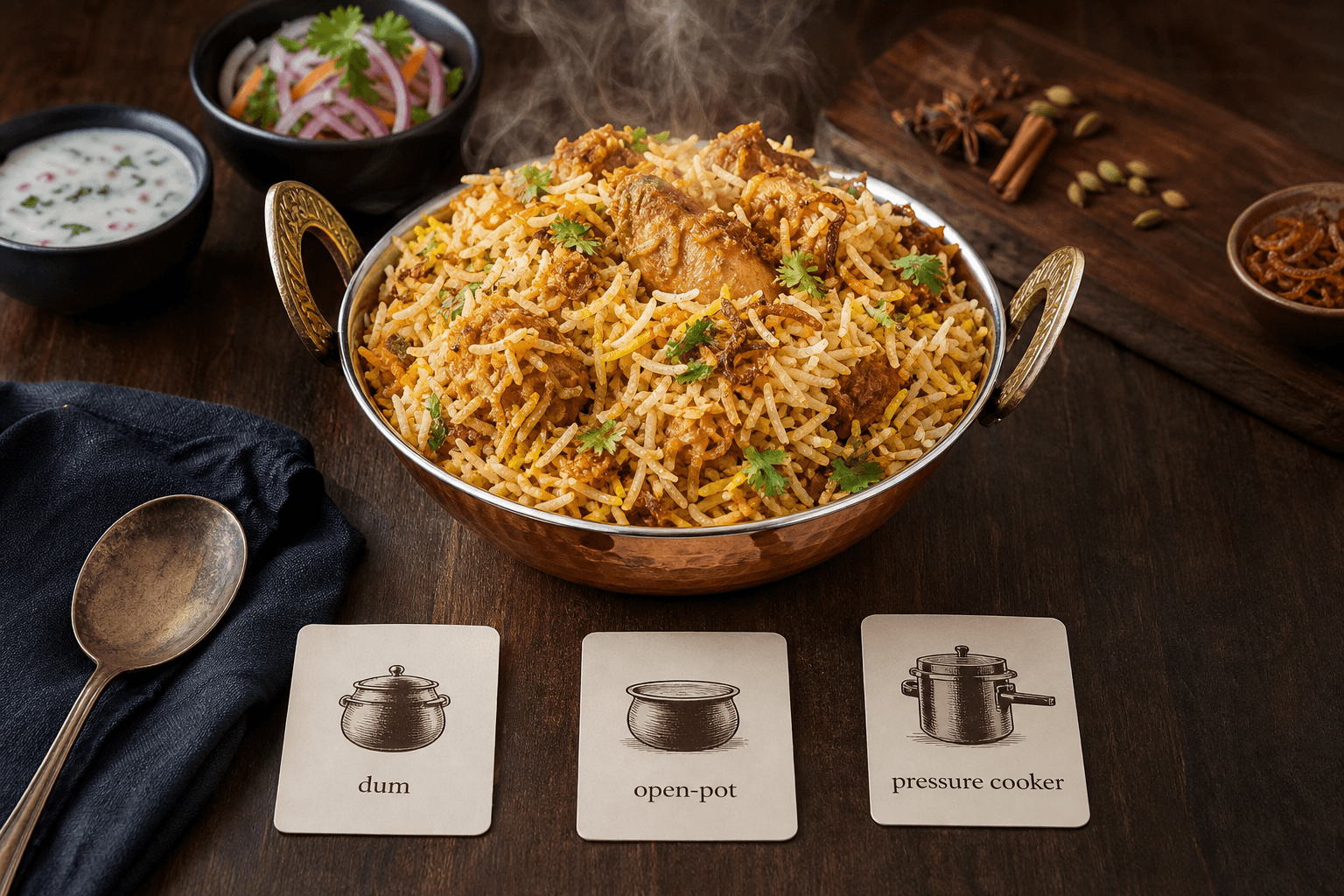
Biryani Methods Compared: Dum, Open-Pot, or Pressure?
The best biryani technique depends on what you value most: close control, direct visibility, contained cooking, or a particular rice texture. Dum, open-pot, and pressure-cooker methods each involve different equipment, attention, and adjustments.
The main differences at a glance
Think of the three techniques as different control systems. Dum cooking emphasizes a covered finishing stage, open-pot cooking emphasizes visibility, and pressure cooking emphasizes a sealed environment. Your preferred method depends on whether you would rather observe and adjust or prepare the process and intervene less frequently.
| Technique | Main focus | Control style | Equipment | May suit |
|---|---|---|---|---|
| Dum | Covered finishing and contained heat | Controlled, with limited visibility once covered | Heavy pot or suitable covered vessel | Cooks who enjoy layered preparation |
| Open-pot | Direct observation of rice and liquid | Hands-on and adjustable | Open cooking pot | Cooks who want to monitor progress |
| Pressure cooker | Contained cooking under pressure | Less visible and more timing-sensitive | Pressure cooker or suitable multicooker | Cooks who prefer a compact process |
This is practical guidance rather than a set of universal rules. Rice, liquid, protein or vegetables, seasoning, vessel, and heat source can change how any technique behaves.
Dum cooking: controlled finishing and layered cooking

Dum cooking generally means finishing biryani in a covered vessel so the ingredients cook in a contained environment. The cover limits direct evaporation and keeps the cooking process enclosed while the rice and other components finish together.
Why cooks choose dum
The main appeal is control over the final stage. Once the ingredients are arranged and the vessel is covered, the cook can focus on maintaining gentle, even heat rather than continually stirring or inspecting the rice. This supports a deliberate approach to layered biryani.
Dum can also appeal to cooks who want prepared ingredients to come together during the finishing stage. That does not guarantee a particular result. Preparation quality, heat distribution, and liquid balance still matter.
Tradeoffs to consider
A covered vessel reduces visibility. If the rice needs more liquid, the heat is too strong, or the bottom cooks faster than the top, the problem may not be obvious immediately. An uneven seal or heat source can create inconsistency, while overcooking can affect texture.
Dum may suit someone who enjoys a structured process and is comfortable making key decisions before covering. It may be less appealing if you prefer to inspect the rice frequently and adjust it as it cooks.
Open-pot cooking: direct visibility and active control
Open-pot biryani is cooked in an uncovered or openly monitored vessel, allowing the cook to observe the rice, liquid, and heat response directly. Its defining feature is the ability to see what is happening and respond during cooking.
Why cooks choose open-pot cooking
Visibility can help cooks learn how a particular rice, vessel, or heat source behaves. You can assess the cooking stage more directly and adjust heat or liquid when the recipe allows it.
This method also makes it easier to compare progress with the intended texture instead of relying entirely on a sealed cooking stage. For a new recipe, that feedback can reveal how quickly liquid is evaporating and how the rice is responding.
Tradeoffs to consider
More visibility requires more attention. Evaporation can change the liquid balance, and frequent stirring or unnecessary handling may affect the rice. The cook must monitor the pot without assuming every visible change calls for an immediate adjustment.
Open-pot cooking may suit someone who values flexibility and direct feedback. It can be less convenient if you want a contained process or cannot stay nearby to monitor the pot.
Pressure-cooker biryani: contained cooking with less manual monitoring
Pressure-cooker biryani uses a sealed pressure environment rather than an open pot or traditional covered finishing setup. Pressure changes how the cook manages heat, liquid, and timing.
Why cooks choose pressure cooking
The contained setup can appeal to cooks who prefer fewer open-pot adjustments. Once the ingredients and settings are chosen, the process may require less direct observation than a method where the rice remains visible.
Pressure cooking may also suit kitchens where this equipment is convenient. For cooks familiar with their pressure cooker, it can provide a repeatable framework, provided the recipe is designed for that equipment.
Tradeoffs to consider
The main limitation is reduced visibility. The cook has less opportunity to inspect the rice midway through the process or correct the balance once the vessel is sealed. Timing and liquid decisions therefore deserve particular attention before cooking begins.
A pressure cooker does not automatically make biryani faster, better, or more consistent. Results depend on the cooker, recipe, ingredients, settings, and the cook’s familiarity with the equipment. Use a recipe designed for pressure cooking rather than transferring open-pot instructions without adjustment.
How to choose between the techniques
Start with the result and cooking experience you want, then choose the method that supports those priorities.
Do you want maximum visibility?
If you want to watch the rice and respond to changes, open-pot cooking offers the most direct view. This can help when learning a recipe, although it still requires careful heat management.
Do you prefer a deliberate covered finish?
Dum may suit cooks who like to prepare the components, arrange them, and finish the biryani in a covered vessel. It places more emphasis on decisions made before covering and less on constant intervention afterward.
Is contained equipment your priority?
A pressure cooker may fit a kitchen where contained cooking is more convenient than managing an open pot. Choose it only when the recipe, cooker, and settings are compatible. The method is less forgiving because the rice cannot be checked as easily.
How much adjustment do you want to make?
Open-pot cooking generally gives the clearest opportunity to adjust during cooking. Dum allows a controlled finishing stage but limits inspection once covered. Pressure cooking offers the least visibility during the sealed portion.
Are you comparing texture fairly?
Rice type, preparation, liquid balance, seasoning, ingredient quantity, vessel size, and heat source all influence the result. Change one major variable at a time if you are trying to understand which method works best.
Common comparison mistakes to avoid
Calling one method automatically more authentic. Biryani is prepared in many styles, and the cooking method alone does not establish authenticity. Describe each method and its tradeoffs without using authenticity as a shortcut for quality.
Assuming the most visible method is easiest. Open-pot cooking lets you see more, but that visibility also creates opportunities for unnecessary intervention.
Changing several variables at once. If you switch the vessel, rice, liquid, heat level, and seasoning together, you will not know which change affected the result.
Treating pressure cooking as a guaranteed shortcut. A pressure cooker changes the environment, but it does not remove the need for suitable ingredients, settings, and timing.
Inferring a restaurant’s process from its menu. A menu can show that biryani is offered, but it does not necessarily document how the kitchen prepares it.
What this comparison says about La Tikka’s biryani
La Tikka Indian Fusion is a casual dining restaurant serving Kitchener and Hamilton, Ontario. Its menu includes rice and biryani dishes alongside North Indian food, Indo-Chinese offerings, Chaat, Tandoori specialties, Momos, thalis, and desserts.
The supplied business information confirms that La Tikka offers dine-in, takeout, reservations, and catering at its two Ontario locations. It does not identify whether the restaurant uses dum, open-pot, pressure cooking, or another preparation process for its biryani.
That distinction matters. This comparison is general cooking education, not a description of La Tikka’s kitchen methods. If preparation is important to your order or event, ask the restaurant directly when making a reservation or catering enquiry.
Frequently asked questions
Can one biryani technique be considered the most authentic?
No single technique should be treated as universally authentic or superior. Biryani is prepared in different regional and household styles, and the vessel is only one part of the method.
Which technique gives the cook the most control?
Open-pot cooking provides the most direct visibility because the rice and liquid can be observed during cooking. Dum offers control through a covered finishing stage, while pressure cooking offers less visibility once sealed.
Does a pressure cooker guarantee faster or better biryani?
No. The outcome depends on the recipe, ingredients, settings, equipment, and timing. A pressure-cooker recipe should be designed for that method rather than copied directly from an open-pot recipe.
Does La Tikka use dum, open-pot, or pressure-cooker techniques?
The supplied information confirms that La Tikka serves biryani but does not document its kitchen technique. It would be inaccurate to claim one method without confirmation from the restaurant.
Choosing your biryani technique
Choose open-pot cooking if direct visibility and active adjustment matter most. Choose dum if you prefer a structured, covered finishing stage. Choose pressure cooking if you have suitable equipment and value a contained process while accepting that inspection is limited.
The fairest comparison is not about naming one method the winner. Match the technique to your equipment, confidence, desired rice texture, preferred monitoring level, and the recipe you are using.
To explore La Tikka’s biryani and other Indian fusion dishes, or to ask about dine-in, takeout, reservations, and catering in Kitchener or Hamilton, visit La Tikka Indian Fusion.