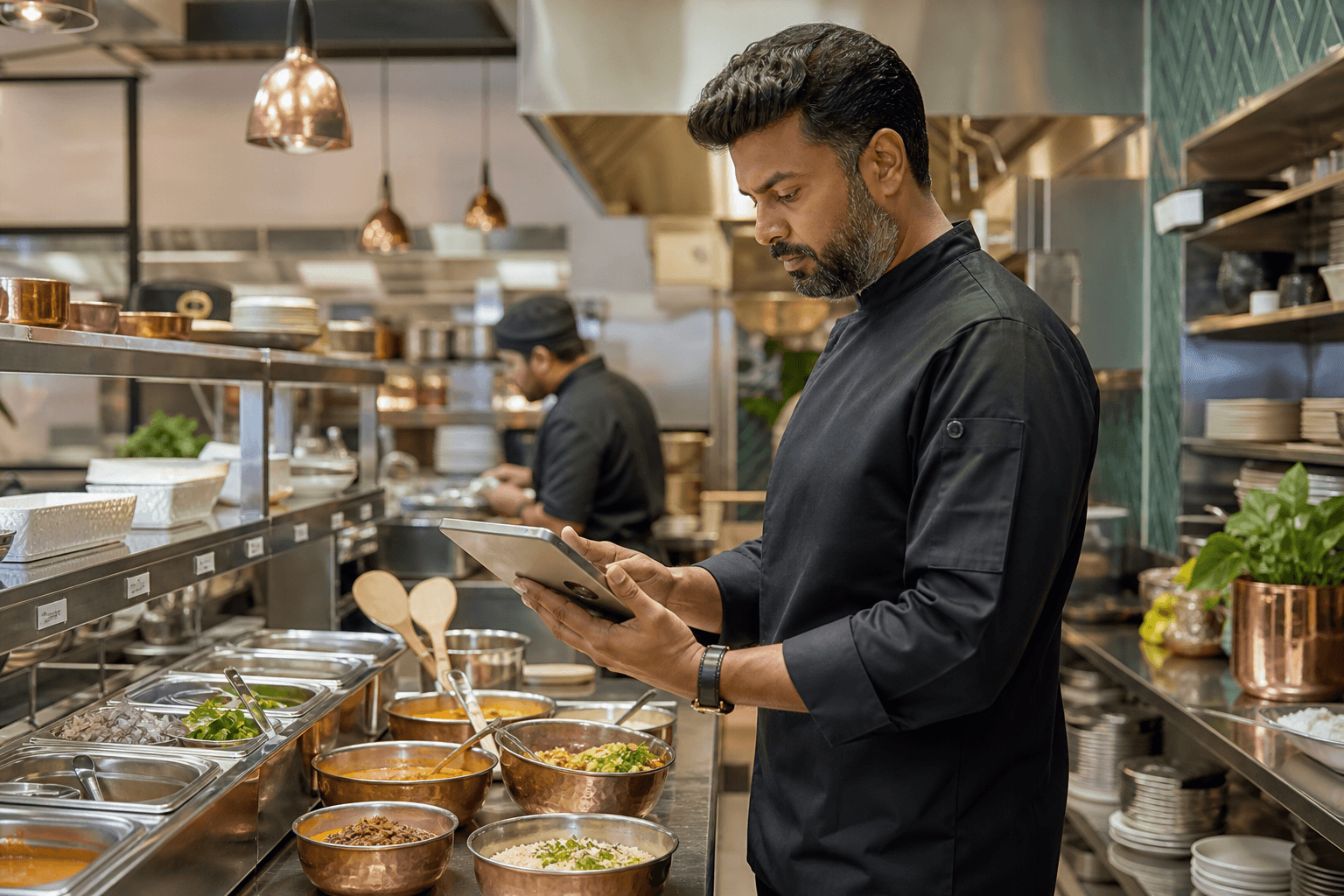
A franchise operations guide is usually a practical restaurant operations manual. It explains how a location should open, prepare food, serve guests, manage stock, train staff, close safely, and respond to problems. It is not the same as Ontario’s franchise disclosure document, which serves a separate legal purpose and must be reviewed independently.
For an Indian fusion restaurant, the strongest manual turns a broad menu and a distinctive guest experience into clear, teachable procedures. It should also show which standards apply everywhere and which must be checked against the premises, municipality, equipment, menu, staffing model, and current regulations.
Quick summary

- Use the guide as an operating manual, not as a substitute for the franchise agreement or disclosure document.
- Cover the full restaurant cycle: opening, preparation, service, takeout, catering, cleaning, closing, records, and incident response.
- Use Indian fusion examples such as chaat, tandoori dishes, sizzlers, Indo-Chinese items, momos, biryani, and thali service as examples to document, not as assumed procedures.
- Standardize brand, safety, quality, and guest-service outcomes, while localizing licensing, premises, equipment, hours, and municipal requirements.
- Test every procedure in a live restaurant, obtain appropriate professional review, train staff, and control revisions with clear version dates.
Franchise operations manual vs. other franchise documents
Before writing or evaluating a guide, separate the documents that govern the business relationship from those that explain daily work. Confusing them can leave a prospective franchise partner without important legal, financial, or operating information.
| Document | Primary purpose | What it should not replace |
|---|---|---|
| Operations manual | Explains repeatable procedures, standards, checklists, roles, and escalation paths. | Legal advice, the franchise agreement, or local approvals. |
| Franchise agreement | Sets contractual rights, duties, fees, territory, term, restrictions, and remedies. | A practical training manual. |
| Disclosure document | Provides prescribed information for a prospective franchisee before signing or paying. | Operating instructions or a promise of profitability. |
| Training materials | Teach specific roles, stations, systems, recipes, safety practices, and service behaviours. | The complete operating and legal framework. |
| Local compliance records | Evidence of applicable licences, inspections, notifications, approvals, and required logs. | System-wide brand standards. |
Ontario’s franchising guidance says a franchisor must provide a disclosure document at least 14 days before a franchisee signs an agreement or makes a payment. It also recommends independent legal and financial advice. That timing requirement belongs to the disclosure process, not to the operations manual. Review Ontario’s franchising information for buyers and owners before relying on any document in a proposed franchise transaction.
What a restaurant franchise operations manual should cover

A useful contents list follows the way a restaurant actually operates. Each section should identify the responsible role, the required result, the steps, the records to complete, and the action to take when something is outside standard.
- Business and brand overview: Define the concept, guest promise, tone of service, approved visual identity, and decision-making responsibilities.
- Premises and equipment: Document room layouts, station ownership, equipment use, maintenance contacts, safety controls, and approved operating limits.
- Opening and closing: Provide timed checklists for readiness, cleaning, preparation, cash or payment systems, waste, security, and handover.
- Food preparation: Set out ingredient specifications, preparation sequences, portioning, holding, presentation, substitutions, and final checks.
- Food safety and sanitation: Explain receiving, storage, hygiene, cleaning, allergen communication, cross-contamination prevention, inspection readiness, and incident escalation.
- Inventory and purchasing: Cover approved specifications, ordering, receiving, stock rotation, counts, waste, shortages, substitutions, and supplier issues.
- People and training: Define roles, onboarding, station sign-offs, coaching, performance expectations, retraining triggers, and escalation routes.
- Guest service: Set standards for greeting, reservations, table service, accessibility, complaints, refunds or corrections, and service recovery authority.
- Off-premise service: Document online orders, packaging, labelling, pickup handoff, catering communication, order accuracy, and delivery responsibilities.
- Records and emergencies: Specify what to record, where records are stored, who reviews them, and what to do during injuries, outages, contamination concerns, fire, or security incidents.
Brand standards and guest experience
Brand standards should describe observable behaviour rather than vague instructions such as “provide excellent service.” A manual might define how quickly a guest is acknowledged, how a reservation is confirmed, who handles a complaint, and when a manager must become involved. These examples require testing and approval before they become formal standards.
An Indian fusion concept may need to explain how staff introduce unfamiliar dishes, discuss spice preferences, describe vegetarian or meat-based options, and prevent assumptions about allergens. It can also set expectations for the presentation of chaat, tandoori specialties, sizzlers, momos, Indo-Chinese dishes, biryani, thalis, beverages, and desserts without requiring every location to use identical décor or staffing.
Local adaptation may be appropriate for dining-room layout, operating hours, late-night service, reservation patterns, and available equipment. The outcome should remain consistent: accurate information, respectful hospitality, safe food, and a clear response when the guest experience falls short.
Opening, shift change, and closing routines
Checklists make daily work visible and reduce reliance on memory. An opening checklist could cover premises condition, staff attendance, equipment status, refrigeration records, washrooms, dining-room setup, cash or payment systems, prep levels, packaging, and reservation notes.
A shift-change procedure should identify what the outgoing team communicates, including shortages, delayed orders, maintenance concerns, guest follow-ups, catering commitments, and unresolved incidents. The incoming lead should acknowledge the handover rather than treating it as an informal conversation.
Closing should cover final food handling, cleaning and sanitizing, waste and recycling, stock protection, cash or payment reconciliation, order-system closeout, security checks, and a record of issues for the next shift. If late-night service is offered, the guide should define final seating and ordering rules clearly.
Menu preparation and quality controls
Recipes alone are not enough. The manual should connect each menu item to approved ingredients, preparation steps, portion size, equipment, holding limits, presentation, permitted substitutions, and a final quality check. It should identify what happens when an ingredient is unavailable or a dish does not meet standard.
For illustration, a guide might use a chaat station to explain cold preparation, topping order, portion control, and allergen communication. A tandoori item or sizzler could demonstrate marination records, cooking verification, safe plating, and presentation checks. Indo-Chinese dishes, momos, biryani, and thali service may require different station flows, holding approaches, garnishes, and guest explanations. These are planning examples, not confirmed procedures for La Tikka.
Quality checks should be practical enough to complete during service. A manager or station lead might verify appearance, temperature where applicable, portion, texture, seasoning, packaging, and order match before dispatch.
Food safety, allergens, and sanitation
Food-safety content must be more than a general promise to keep the kitchen clean. It should explain how food is received from approved sources, stored, labelled, rotated, prepared, held, cooled or reheated where applicable, and discarded. It should also identify who checks records and what happens when a check fails.
Ontario’s food-premises regulation addresses requirements including inspected food sources and the posting of inspection results when requested by a public-health inspector. A restaurant intending to operate as a food premise must also give notice to the relevant medical officer of health under the Health Protection and Promotion Act. The manual should support those obligations, not claim to replace public-health direction.
Allergen procedures should tell staff what information they may provide, how they confirm ingredients, how they record a guest concern, and when they must involve a manager. Include cleaning schedules, chemical handling, pest-prevention reporting, hand hygiene, illness escalation, and inspection response. Have qualified food-safety professionals review this section before implementation.
Inventory, suppliers, and cost controls
Inventory procedures should connect purchasing decisions to food quality and operational continuity. Document approved product specifications, ordering points, receiving checks, storage locations, date marking, stock rotation, count frequency, waste categories, and the approval process for substitutions.
A broad Indian fusion menu may include spices, dairy, produce, proteins, rice, breads, sauces, frozen items, beverages, packaging, and specialty garnishes. The manual should explain how a location reports a shortage and whether it may replace an item, remove a dish temporarily, or seek approval before changing a recipe.
Staffing, training, and performance standards
Every procedure needs an owner. Assign responsibilities for opening, receiving, preparation, service, cleaning, stock counts, incident reporting, and closing. Then map each role to training materials, supervised practice, and a sign-off that shows the person can perform the task.
Training should combine explanation, demonstration, practice, observation, and correction. Useful records may include station checklists, food-safety training, equipment sign-offs, service coaching, and retraining after a complaint, failed audit, recipe change, equipment replacement, or regulatory update.
La Tikka Indian Fusion is described as a casual dining brand serving Kitchener and Hamilton, with dine-in, takeout, reservations, catering, and Indian fusion and Indo-Chinese offerings. Those facts can inform illustrative scenarios, but a prospective franchise partner should request the actual training process and operating materials being offered.
Takeout, catering, reservations, and group service
Off-premise service needs its own procedures because the guest may not discover an error until the restaurant is far away. Document order entry, item availability, modifications, allergen notes, packaging, labelling, staging, pickup identification, handoff, payment, and complaint handling.
Catering procedures should clarify who confirms the event date, guest count, menu, dietary information, service format, timing, equipment, delivery or collection, payment, and changes. Reservation procedures should cover table capacity, confirmation, late arrivals, large groups, accessibility requests, and communication between the booking channel and dining-room team.
What to standardize and what to localize
| Usually system-wide | May require local adaptation |
|---|---|
| Brand voice, approved menu descriptions, food-safety principles, service recovery values, quality outcomes, training records, and incident escalation. | Premises layout, equipment, storage capacity, municipal licences, health-unit contacts, operating hours, staffing availability, and local customer patterns. |
| Recipe specifications, portion targets, approved substitutions, packaging standards, and required records. | Supplier availability, delivery routes, menu availability, waste collection, parking or pickup flow, and location-specific late-night procedures. |
Use a local addendum rather than quietly editing the main manual. That keeps the core standard visible while showing which procedures depend on the municipality, premises, equipment, menu, or licensing conditions.
Ontario compliance checkpoint
Ontario’s franchise rules require more than a well-written manual. The regulation on disclosure documents specifies information about the franchisor’s business background, among other prescribed content. Read the applicable Ontario disclosure regulation with an independent franchise lawyer rather than treating this article as legal advice.
For restaurant operations, confirm the applicable food-premises requirements, health-unit notification, inspection practices, staff obligations, and municipal licensing before opening or changing a location. Kitchener and Hamilton may not have identical processes. The manual should provide a place to record the responsible authority, approval status, renewal date, and evidence.
Menu information may also require review. Ontario’s menu-labelling guidance helps regulated food-service premises understand implementation considerations. Whether it applies to a particular location or menu should be confirmed by the operator and relevant advisers.
How to build, test, and update the manual
- Inventory current practice: Observe a full service cycle and collect existing checklists, recipes, training records, supplier information, incident logs, and local approvals.
- Draft for action: Write one procedure per task using a consistent structure: purpose, owner, tools, steps, safety points, record, exception, and escalation.
- Obtain specialist review: Ask legal, financial, food-safety, insurance, and municipal professionals to review the parts within their expertise.
- Test in a live setting: Have staff follow the procedure during normal and busy periods. Record unclear wording, missing tools, timing problems, and unsafe workarounds.
- Train and sign off: Explain the reason for the standard, demonstrate it, observe practice, and record competency.
- Control versions: Give every document an owner, version number, effective date, change summary, and review date. Remove obsolete copies.
- Review after change: Reassess the guide after menu, supplier, equipment, premises, hours, staffing, incident, or regulatory changes.
Checklist for evaluating an operations manual
- Does it cover opening through closing, including exceptions and emergencies?
- Are food preparation, sanitation, allergens, storage, receiving, and waste procedures specific enough to follow?
- Does every important task have an owner, record, escalation path, and training method?
- Are menu examples, recipes, suppliers, and equipment clearly identified as approved standards rather than assumptions?
- Does it distinguish system-wide requirements from local addenda?
- Is there evidence that staff tested the procedures in a real restaurant?
- Are revision dates, document ownership, update triggers, and obsolete-copy controls visible?
- Does the manual remain separate from the franchise agreement and disclosure document?
- Have appropriate legal, financial, food-safety, insurance, and municipal reviewers been identified?
Questions to ask before relying on the guide
- Who owns the manual, and who may approve changes?
- Which procedures are mandatory, and which are examples or recommendations?
- When was each section last tested at a live location?
- What training, coaching, technology, and opening support accompany the manual?
- How are local licences, health-unit requirements, inspections, and menu obligations tracked?
- What flexibility exists for suppliers, equipment, staffing, operating hours, and menu availability?
- What happens if the manual conflicts with the franchise agreement, disclosure document, law, or public-health direction?
- Who pays for required equipment, training, updates, repairs, and compliance changes?
- How are complaints, food-safety incidents, recalls, and service failures reported and reviewed?
Frequently asked questions
Is a franchise operations manual legally required in Ontario?
The supplied Ontario materials focus on franchise disclosure obligations and food-premises requirements, not a separate document called an operations manual. A manual is a practical management tool, but its contents and use should be reviewed with a franchise lawyer and relevant compliance professionals.
What is the difference between a franchise operations manual and a disclosure document?
The operations manual explains how to run the restaurant. The disclosure document provides prescribed information to a prospective franchisee before signing or paying. One does not replace the other.
Can one restaurant operations manual be used at multiple locations?
Yes, a core manual can support multiple locations, but it should include controlled local addenda. Premises, equipment, suppliers, municipal requirements, health-unit contacts, hours, staffing, and menu availability may differ.
Who should review an Ontario restaurant franchise operations manual?
A franchise lawyer should review the relationship and document hierarchy, a financial professional should review financial assumptions and obligations, and qualified food-safety and municipal advisers should review operational compliance. Managers and staff should test usability in practice.
How often should a franchise operations manual be updated?
Use a scheduled review at least annually as a planning discipline, but update sooner after a regulatory change, menu or supplier change, equipment replacement, incident, inspection finding, or process failure.
Build a guide that can be followed, tested, and trusted
The best franchise operations guide is not the longest document. It is a controlled operating system that makes important work clear, assigns responsibility, records exceptions, supports training, and separates repeatable brand standards from location-specific requirements.
For an Indian fusion restaurant, that means documenting the complete guest and kitchen journey while allowing the menu, equipment, premises, suppliers, hours, and local compliance obligations to be verified at each location. Keep the manual distinct from the franchise agreement and disclosure document, and obtain independent professional review before relying on it for a franchise decision.
La Tikka Indian Fusion describes franchise interest as part of its growth direction and serves Kitchener and Hamilton with Indian fusion dining, takeout, reservations, and catering. Prospective partners interested in that direction can review current information through La Tikka Indian Fusion.